
Securing commercial premises demands a structured approach to building entry systems, ensuring only authorised individuals gain access while maintaining a fluid environment for daily operations. Modern entry mechanisms have evolved from simple setups to sophisticated electronic networks that monitor and control movement across various zones. Facility managers face the challenge of selecting hardware and software that integrate seamlessly with existing infrastructure without causing operational friction. By focusing on fundamental design strategies and preventative maintenance, organisations can establish a secure perimeter that protects physical assets and personnel. This article explores practical methods for enhancing the reliability of commercial access configurations.
Key Takeaways:
Assess physical layout to define secure perimeters accurately.
Select access credentials that suit the workforce environment.
Utilise professional network cabling services for infrastructure.
Integrate entry controls with existing emergency evacuation plans.
Implement routine hardware audits to prevent unexpected failures.
Evaluating Physical Layout And Zoning
The initial phase of designing a secure entry network involves a thorough examination of the architectural layout to identify vulnerable access points. Security consultants typically divide a facility into distinct zones, ranging from public reception areas to restricted server rooms, each requiring specific authentication. Mapping these transition points helps administrators determine exactly where physical barriers and electronic readers need placement to effectively channel foot traffic. This systematic zoning process prevents individuals from wandering into sensitive areas without clearance, forming the foundation of a robust spatial security strategy.
Once internal zones are clearly defined, attention must turn to the external perimeter and primary entryways serving as the first line of defence. Turnstiles, optical gates, and reinforced doors must align with the architectural aesthetics while providing deterrence against forced entry. The choice of barrier directly impacts the flow rate of personnel during peak hours, necessitating a balance between strict security measures and operational convenience. Assessing the volume of daily traffic helps in selecting hardware that can withstand constant use without creating physical bottlenecks during morning arrivals.
Selecting Appropriate Authentication Methods
The choice of credential plays a critical role in the user experience and the overall integrity of the entry system. Traditional radio frequency identification cards remain prevalent in corporate settings due to their low cost, though they are susceptible to loss and cloning. To address these vulnerabilities, facilities are transitioning towards smart credentials and mobile access solutions that utilise encrypted signals stored securely on a smartphone. These modern formats offer heightened security by tying the access token to a personal device that individuals rarely leave unattended.
For environments demanding strict identity verification, biometric scanners provide a reliable alternative to physical cards or mobile applications. Fingerprint readers and facial recognition terminals authenticate the actual person rather than a transferable token, reducing the risk of unauthorised access through stolen credentials. When implementing biometrics, facility managers must consider environmental factors that might affect sensor accuracy, such as direct sunlight or heavy dust accumulation. Organisations must also establish clear data handling policies to address privacy concerns regarding the storage and processing of sensitive biometric templates within the central database.
Infrastructure And Data Cabling Considerations
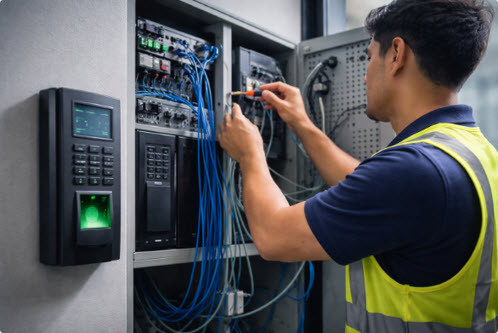
The reliability of an electronic entry network relies heavily on the quality of its underlying physical infrastructure and data pathways. Deploying secure connections between readers, controllers, and central servers is essential for preventing communication drops that could leave doors locked or vulnerable. Relying on professional network cabling services ensures that all wiring meets strict industry standards and is adequately shielded from electromagnetic interference. Proper cable management not only guarantees stable data transmission but also simplifies future troubleshooting and hardware upgrades as the organisation expands its physical footprint.
Beyond data cables, power distribution requires careful planning to maintain continuous operation during unexpected utility outages. Door controllers and electronic locking mechanisms need a dedicated power supply equipped with battery backups to sustain functionality when the main grid fails. Engineers must calculate the total electrical load of all connected devices to prevent circuit overloads that could trigger a widespread system failure. A decentralised approach to power distribution, where multiple power units serve distinct clusters of doors, limits the impact of a single hardware fault and preserves the wider security perimeter.
Integrating Emergency Evacuation Protocols
A fundamental requirement of any building entry system is its ability to facilitate safe and rapid evacuation during critical emergencies. Electronic locks must be intrinsically linked to the central fire alarm panel, ensuring doors automatically disengage the moment a threat is detected. This seamless integration allows occupants to exit the premises without encountering locked barriers, directly supporting life safety regulations. Designing a system that fails open during a fire alarm is a mandatory compliance measure that protects human life and shields the organisation from severe legal liabilities.
While automated systems handle primary evacuation needs, manual override mechanisms must also be installed at all designated emergency exits. Break-glass call points and push-to-exit buttons provide individuals with a physical method to release the door lock if the software integration fails to activate. These secondary devices are crucial during localised power failures or unexpected controller malfunctions that might otherwise trap personnel inside a secure zone. Regular consultation with local fire safety officers during installation guarantees that all electronic barriers and manual overrides meet regional building codes and safety standards.
Convergence With Video Surveillance Networks
Connecting entry control mechanisms with closed-circuit television networks creates a cohesive security environment that significantly improves situational awareness. When an access token is rejected or a door is forced open, the integrated software can automatically direct nearby cameras to record the incident and display the live feed to monitoring staff. This immediate visual context allows security teams to assess the nature of the alert quickly, determining whether it is a genuine intrusion attempt or a simple user error. Tying access logs to video timestamps provides an undeniable record for investigations.
Achieving this operational synergy requires selecting software platforms that feature open application programming interfaces. An open architecture allows the entry management database to communicate effortlessly with video recording servers, consolidating all security alerts into a single, unified dashboard. This centralised approach eliminates the need for operators to toggle between disjointed applications, reducing response times and improving overall efficiency. By streamlining the monitoring process, a smaller team of security personnel can oversee larger and more complex facilities without suffering from alert fatigue or missing critical security breaches.
Establishing Routine Maintenance Schedules
The long-term viability of a commercial entry system depends on a proactive approach to hardware maintenance and software management. Physical components such as door strikes, magnetic locks, and card readers endure constant daily use, making them susceptible to mechanical wear and environmental degradation. Implementing a scheduled maintenance programme allows technicians to inspect these devices, clean optical sensors, and adjust door alignments before minor issues escalate into complete hardware failures. Regularly testing battery backups and power supplies is crucial to ensure the system remains operational during unexpected electrical outages.
Parallel to physical upkeep, the software database requires periodic auditing to maintain an accurate register of active personnel and their access privileges. As employees change roles or depart the organisation, their credentials must be promptly updated or revoked to prevent redundant accounts from becoming security liabilities. Administrators should routinely review access logs to identify unusual entry patterns or repeated access denials that might indicate a compromised credential. Diligent database management upholds the principle of least privilege, ensuring the entry system accurately reflects the current workforce and provides sustained protection.
Read another Article: Professional Standards for Modern Access Control System Design